USA vs China in 2026: Who Leads the World?
For more than two decades of rivalry between the United States and China has shaped global politics, economics, technology, and international security. Every major geopolitical event—from trade disputes and technological competition to military modernization and diplomatic alliances—has been influenced by the growing competition between these two giants.
As we move through 2026, one question continues to dominate discussions among policymakers, business leaders, investors, and ordinary citizens:
Who is the world’s leading superpower—the United States or China?
The answer is more nuanced than many news headlines suggest.
While the United States remains the world’s largest military power and the centre of global finance and innovation, China has emerged as the world’s manufacturing powerhouse and one of the fastest-growing technological and economic power. Each country leads in different areas, making their rivalry one of the defining stories of the 21st century.
In this in-depth comparison, we examine their history, geography, economies, demographics, technology, and global influence to understand where each nation stands today and in future.
A Brief History of Two Superpowers
The United States did not become the world’s leading power overnight. After getting independence exactly 250 years ago, its rise accelerated during the 20th century, particularly after the First and Second World Wars. While much of Europe and Asia were rebuilding after World War II, the American economy expanded rapidly. The country became the driving force behind establishment of institutions such as the United Nations, the International Monetary Fund, and the World Bank. During the Cold War, the United States competed with the Soviet Union for global influence and emerged as the world’s sole superpower after the dissolution of the Soviet Union in 1991 into 15 independent nations.
China’s modern transformation followed a different path.
After the establishment of the People’s Republic of China in 1949, the country spent decades rebuilding its economy. A turning point came in 1978 when economic reforms opened China to foreign investment and market-oriented development. Over the following decades, China became the “factory of the world,” producing everything from consumer electronics to industrial machinery.
China’s accession to the World Trade Organization in 2001 accelerated its integration into the global economy. Since then, hundreds of millions of people have been lifted out of poverty, and Chinese companies have become global competitors in sectors such as telecommunications, renewable energy, electric vehicles, and advanced manufacturing.
Today, both nations influence almost every aspect of global affairs.
Geography: Size and Strategic Advantages
Geography has always played a crucial role in shaping a country as an international power.
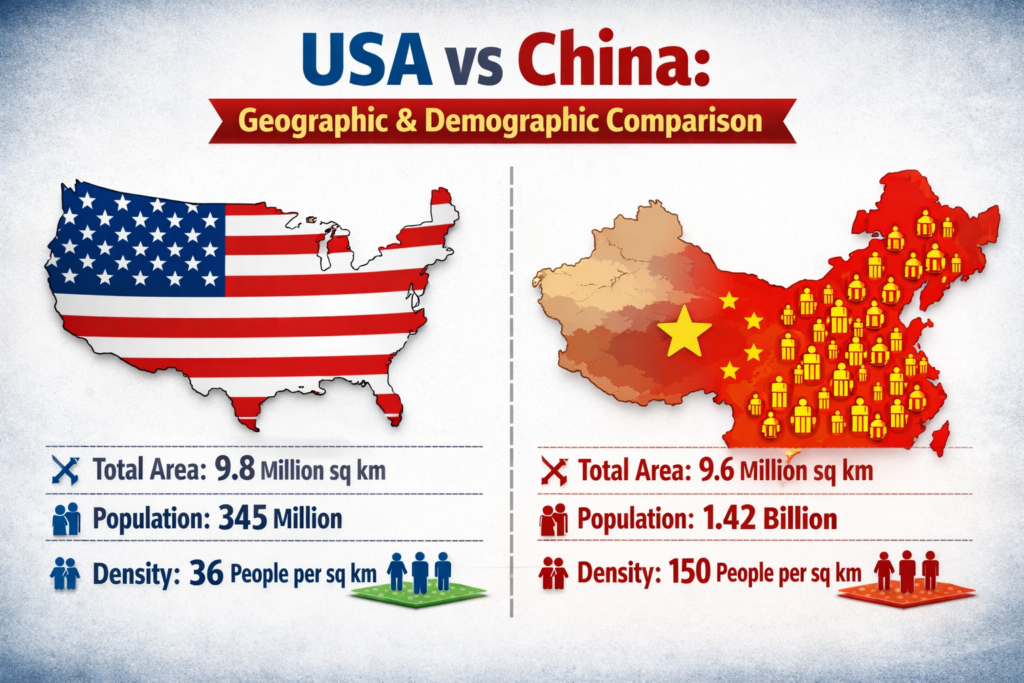
The United States covers approximately 9.8 million square kilometers, making it the world’s third largest country by land area. It benefits from vast natural resources, fertile agricultural land, navigable rivers, and coastlines on both the Atlantic and Pacific Oceans. These geographic advantages support trade, food security, and military mobility.
China, covering approximately 9.6 million square kilometers,nearly equal in size to the US, possesses remarkable geographic diversity. Its landscape ranges from the Himalayan mountains and Tibetan Plateau to deserts, forests, fertile river basins, and long eastern coastlines facing the Pacific Ocean.
China shares borders with 14 countries, creating both opportunities for trade and challenges related to regional security. India, another military power, has border disputes with China and shares a border of nearly 3488 kilometres. In contrast, the United States shares land borders with only Canada and Mexico, giving it a comparatively secure strategic position.
From a geographic security perspective, the United States enjoys a natural advantage as it is located far from other challenging global superpowers and fewer immediate security threats. China, however, occupies a central position in Asia, allowing it to influence one of the world’s most economically dynamic regions.
Population: A Tale of Two Demographic Trends
Population remains one of the most important indicators of long-term national strength.
China has a population of around 1.4 billion people, making it one of the world’s most populous countries. This enormous workforce helped transform China into a global manufacturing powerhouse.
However, demographic trends have begun to shift. Lower birth rates, an aging population, and a shrinking workforce are creating long-term economic challenges. Policymakers are encouraging larger families, but reversing demographic trends may take decades.
The United States, with a population of more than 340 million people, is four times smaller than China in absolute numbers. Yet its demographic outlook is comparatively stronger because population growth is supported by immigration as well as natural increase.
A younger workforce can help sustain innovation, entrepreneurship, and long-term economic growth. Many economists believe this demographic advantage may become increasingly important over the coming decades.
Economic Power: The World’s Two Largest Economies
The economic competition between the United States and China lies at the heart of their global rivalry.
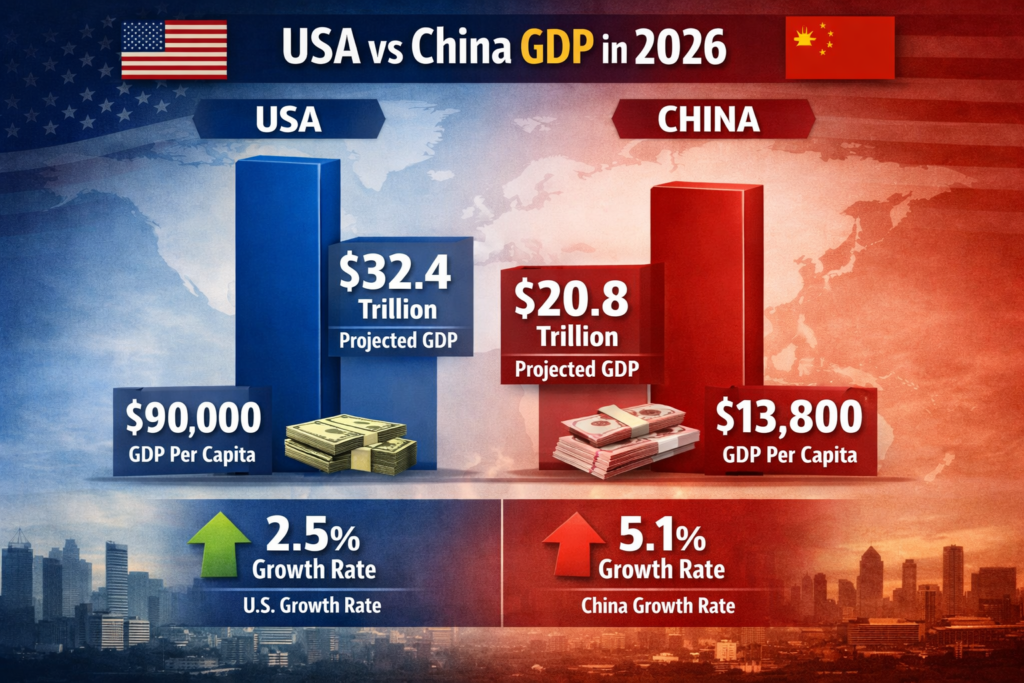
The United States remains the world’s largest economy with a size $ 32.38 trillion by nominal GDP. Its economy is driven by consumer spending, financial services, advanced technology, healthcare, entertainment, aerospace, and high-value innovation.
American companies dominate many global industries, including software, cloud computing, semiconductor design, biotechnology, and artificial intelligence. The U.S. dollar also continues to serve as the world’s primary reserve currency, giving the country significant influence over international finance and trade.
China, meanwhile, has built an economy centred on manufacturing, exports, infrastructure development, and increasingly sophisticated technology industries. It is the world’s largest exporter of goods and an essential part of the global supply chain.
Over the past two decades, China has invested heavily in transportation networks, ports, renewable energy, high-speed rail, and industrial capacity. These investments have strengthened its domestic economy while expanding its international economic influence.
The competition between the two economies is no longer about size alone. Increasingly, it is about who will lead the industries of the future—including artificial intelligence, robotics, clean energy, advanced manufacturing, and quantum technologies.
Trade and Manufacturing
China is often called “the world’s factory,” and for good reason.
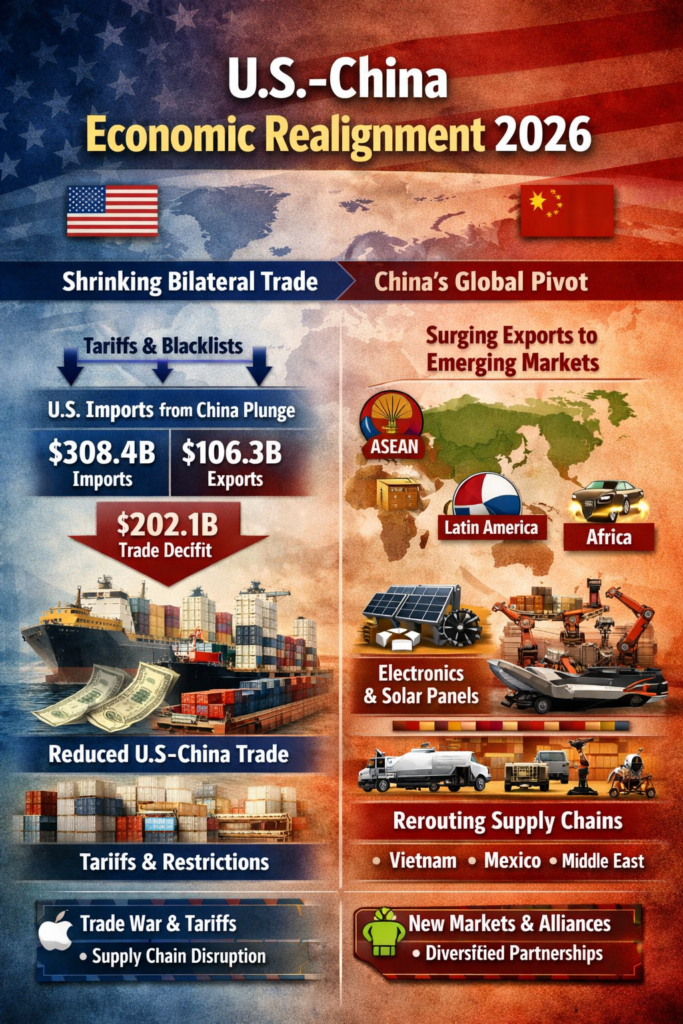
From smartphones and computers to household appliances and industrial equipment, Chinese factories produce a substantial share of the goods used around the world. Efficient manufacturing ecosystems, skilled labor, and large-scale industrial clusters have made China a cornerstone of global production.
The United States, by contrast, excels in high-value manufacturing, aerospace, pharmaceuticals, semiconductor design, defence industries, and advanced research. American firms frequently focus on innovation, design, and intellectual property while maintaining global production networks.
In recent years, both countries have sought to reduce strategic dependence on one another. Governments and businesses are diversifying supply chains, investing in domestic manufacturing, and strengthening economic resilience.
As a result, the economic relationship between the United States and China is becoming more competitive while remaining deeply interconnected.
Looking Ahead
History shows that global leadership is rarely determined by a single factor. Geography, demographics, economic strength, innovation, military capability, diplomacy, and institutional resilience all play important roles.
In 2026, neither the United States nor China can claim unquestioned dominance across every domain. Each possesses unique strengths that continue to shape the international system.
Military Power: Who Has the Stronger Armed Forces?
Military strength has long been one of the most visible indicators of global power. While economic performance shapes long-term influence, military capability determines how effectively a country can protect its interests and respond to international crises.
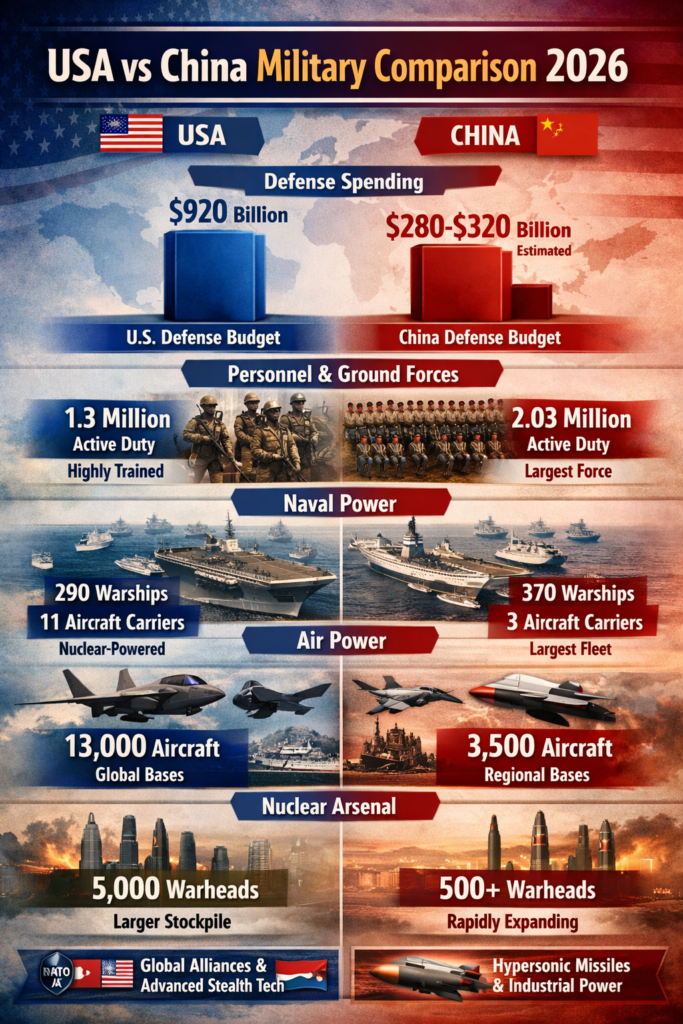
United States: Global Reach
The United States continues to possess the world’s most capable military force in terms of global reach. It maintains hundreds of military facilities and cooperative security arrangements across multiple continents, allowing rapid deployment almost anywhere in the world.
Several factors contribute to America’s military advantage:
- Advanced stealth aircraft and strategic bombers
- Nuclear-powered aircraft carriers capable of worldwide operations
- Extensive intelligence and surveillance capabilities
- Highly sophisticated missile defense systems
- Strong logistics and overseas support infrastructure
- Long-standing defense partnerships with allies across Europe and the Indo-Pacific
The U.S. defense industry also remains a global leader in developing next-generation technologies, including autonomous systems, cyber capabilities, and advanced precision weapons.
China: Rapid Modernization
China’s military has undergone one of the fastest modernization programs in modern history.
Over the past two decades, Beijing has invested heavily in naval expansion, missile technology, cyber warfare, artificial intelligence, satellite systems, and advanced fighter aircraft. China’s primary objective is to strengthen its ability to defend its territory, secure regional interests, and project greater influence in the Indo-Pacific.
The country’s rapidly expanding navy reflects this ambition, while investments in hypersonic technologies and electronic warfare demonstrate its focus on future conflicts.
Who Has the Advantage?
In terms of worldwide operational capability, the United States still holds a significant edge because of its global alliances, overseas bases, combat experience, and logistical network.
China, however, has substantially narrowed the technological gap and has become a formidable military power within its surrounding region. Many analysts expect competition in advanced military technologies to remain intense throughout the coming decade.
Technology and Artificial Intelligence
The next great contest between the two superpowers is taking place in laboratories, data centres, and semiconductor fabrication facilities.
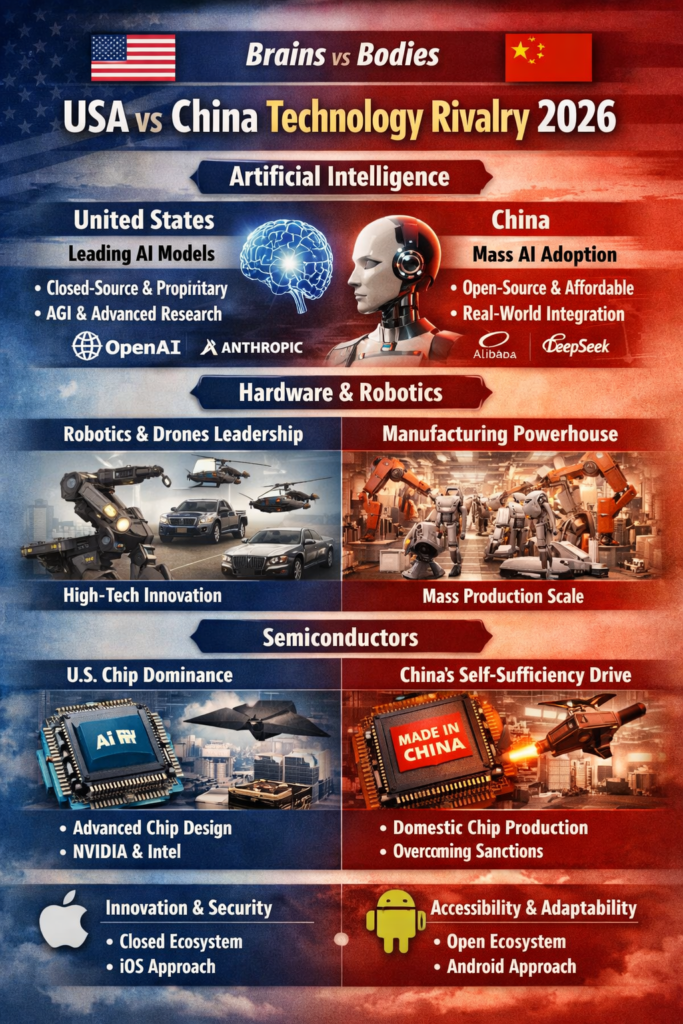
United States: Innovation Leadership
The United States continues to lead in several high-value technology sectors.
Many of the world’s most influential technology companies originated in the United States, shaping global software, cloud computing, artificial intelligence, biotechnology, and semiconductor design.
American universities, research institutions, and venture capital ecosystems consistently produce breakthrough innovations that influence industries worldwide.
The country’s strengths include:
- Artificial intelligence research
- Semiconductor design
- Biotechnology
- Aerospace innovation
- Cloud computing
- Software development
- Advanced robotics
China: Scaling Innovation
China has shifted from being primarily a manufacturing economy to becoming a significant technology innovator.
Government support, private-sector investment, and a large domestic market have accelerated advances in:
- Electric vehicles
- Renewable energy
- High-speed rail
- 5G telecommunications
- Digital payments
- Artificial intelligence applications
- Smart manufacturing
Chinese firms increasingly compete in international markets, particularly across Asia, Africa, Latin America, and the Middle East.
Rather than simply adopting foreign technologies, many Chinese companies now develop competitive products and research capabilities of their own.
The Space Race Returns
Space exploration has become another arena of strategic competition.
The United States maintains decades of experience in human spaceflight, deep-space exploration, commercial launch services, and scientific research. Partnerships between government agencies and private companies have transformed access to space.
China has also achieved remarkable progress within a relatively short period. Its successful lunar missions, space station development, and expanding launch capabilities demonstrate long-term ambitions in space science and exploration.
As both countries invest in lunar exploration, satellite infrastructure, and future missions, space is expected to remain an important dimension of geopolitical competition.
Diplomacy and Global Influence
Power is measured not only by military strength or economic size but also by the ability to build partnerships and shape international institutions.
The United States
The United States maintains extensive diplomatic relationships and security partnerships around the world. Cooperation with allies has been a cornerstone of its foreign policy for decades.
American influence is reinforced by:
- Global financial institutions
- International development programs
- Educational exchanges
- Cultural exports
- Scientific collaboration
- Global media reach
China
China has expanded its diplomatic and economic engagement through infrastructure investment, trade partnerships, and development financing.
Its growing presence across Asia, Africa, Latin America, and parts of Europe reflects an effort to strengthen economic connectivity and broaden international influence.
Rather than replacing existing global institutions outright, China has also sought a larger role within international organizations while creating new avenues for regional cooperation.
Education and Research
Knowledge drives long-term national competitiveness.
The United States continues to attract talented students, researchers, entrepreneurs, and innovators from around the world. Many leading universities remain global centres for scientific research and technological breakthroughs.
China has invested heavily in higher education and scientific research over the past two decades. Increasing funding, modern laboratories, and international collaboration have significantly strengthened its research capabilities.
Competition in scientific publications, patents, and emerging technologies is expected to remain one of the defining features of U.S.–China relations.
Infrastructure
Infrastructure illustrates the different development models followed by the two countries.
China has built extensive high-speed rail networks, modern airports, ports, bridges, and industrial zones within a relatively short period. Large-scale public investment has transformed domestic connectivity.
The United States possesses highly developed infrastructure in many areas but also faces the challenge of modernizing aging transportation systems, bridges, and public utilities. Ongoing investment aims to improve resilience and competitiveness.
Each model reflects different economic priorities and governance approaches.
Soft Power: Winning Hearts and Minds
Influence extends beyond economics and military capability.
American films, music, sports, universities, technology companies, and entrepreneurial culture continue to shape global popular culture.
China has expanded its international cultural outreach through tourism, education, media, language programs, and business partnerships. Although its cultural influence has grown, it remains more regionally concentrated compared with America’s longstanding global reach.
Soft power often develops gradually and complements economic and diplomatic relationships rather than replacing them.
Strengths and Challenges
United States
Strengths
- World’s largest nominal economy
- Global reserve currency
- Leadership in innovation and entrepreneurship
- Strong military projection
- World-class universities
- Extensive alliance network
- Deep financial markets
Challenges
- Political polarization
- Infrastructure modernization needs
- Rising national debt
- Supply chain resilience
- Intensifying global competition
China
Strengths
- Manufacturing powerhouse
- Large domestic market
- Advanced infrastructure
- Rapid technological development
- Strong industrial capacity
- Expanding global trade relationships
Challenges
- Aging population
- Property-sector pressures
- Regional security tensions
- Balancing economic growth with structural reforms
- Maintaining productivity as demographics change
Who Is the Boss in 2026?
The answer depends on the yardstick used.
If the comparison focuses on military reach, financial influence, higher education, global alliances, and the international role of the U.S. dollar, the United States retains significant advantages.
If the focus is manufacturing capacity, infrastructure development, export strength, and industrial scale, China stands out as a global leader.
In technology, both countries are advancing rapidly, with each leading in different segments.
Rather than one nation clearly replacing the other, today’s world is increasingly characterized by strategic competition between two exceptionally powerful countries whose strengths often complement—and challenge—each other.
For governments, businesses, and investors, understanding both powers is more valuable than assuming a single winner.
Final Verdict
The geopolitical landscape of 2026 is not dominated by a single country in every field.
The United States remains the leading comprehensive global power thanks to its combination of military capability, financial influence, innovation ecosystem, higher education, and alliance network.
China, meanwhile, has become an indispensable economic and technological power whose influence continues to expand through manufacturing, trade, infrastructure, and scientific progress.
Instead of asking whether one country has completely overtaken the other, a better question is how their competition will reshape the decades ahead.
Their rivalry is likely to influence global economics, technological innovation, climate cooperation, international security, and diplomatic relations for years to come.
The ultimate “boss” of the 21st century may not be determined by a single statistic, but by which nation adapts most effectively to future challenges while fostering sustainable prosperity and constructive international engagement.
Frequently Asked Questions
Is China more powerful than the USA in 2026?
China is exceptionally strong in manufacturing, exports, and infrastructure. The United States retains broader advantages in global military reach, finance, higher education, and worldwide alliance networks.
Which country has the larger economy?
By nominal GDP, the United States remains the larger economy. China is among the world’s largest economies and continues to play a central role in global trade.
Who has the stronger military?
The United States generally maintains greater global power-projection capabilities. China has rapidly modernized its armed forces and is a major military power, particularly within the Indo-Pacific region.
Which country is more advanced in technology?
Both countries lead in different sectors. The United States is especially strong in software, semiconductor design, biotechnology, and frontier research, while China excels in advanced manufacturing, electric vehicles, digital payments, and large-scale technology deployment.
Will China surpass the United States?
Future outcomes depend on economic growth, demographics, innovation, productivity, international partnerships, and domestic policy choices. There is no consensus that one country will definitively surpass the other across every measure.